
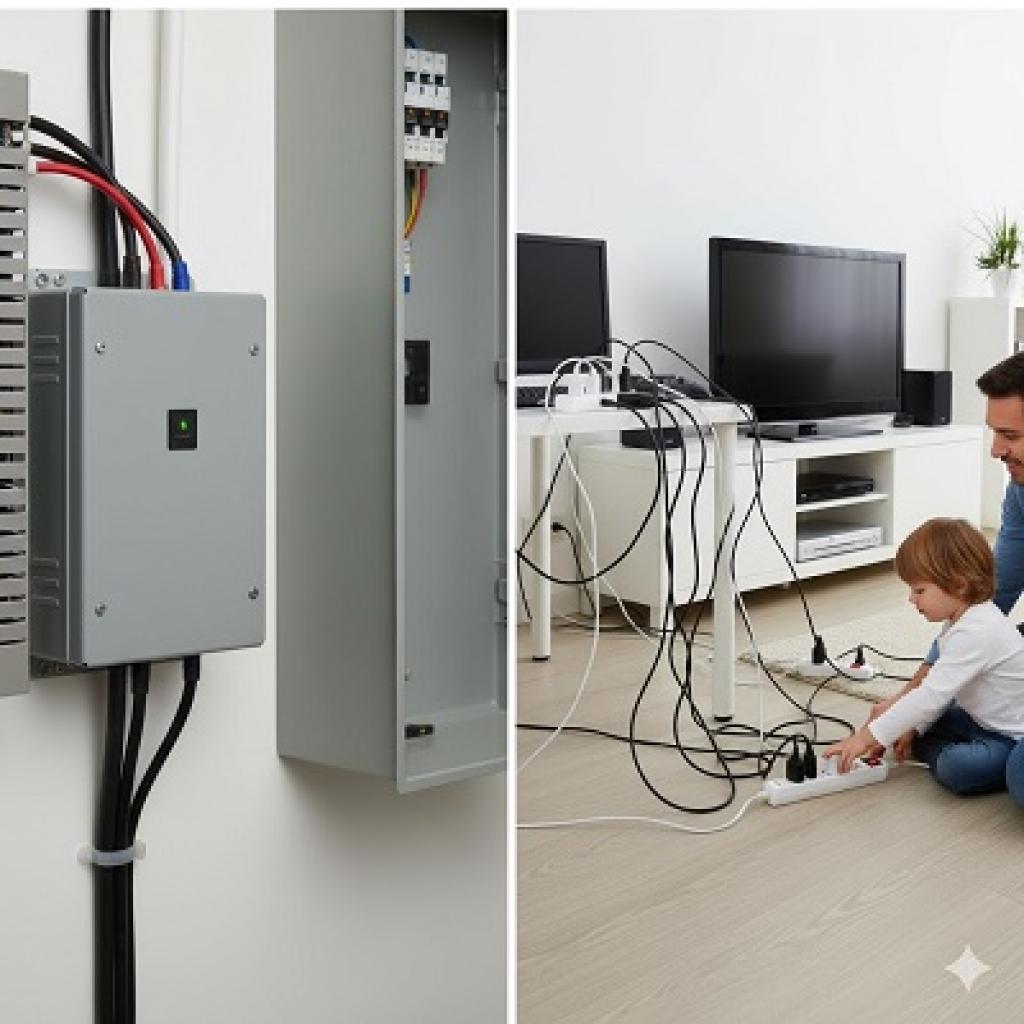
If you’ve ever worried about a lightning storm frying your TV or a sudden power surge killing your new fridge, you’re not alone. Many homeowners wonder if a home surge protector at the electrical panel is really worth it, or if they can just plug everything into cheap power strips and call it a day. At Atomic Electric & Generators Inc., we get this question all the time, and the answer depends on how much risk you’re willing to take with your home’s electronics and appliances.
In this guide, we’ll break down how each option works, where each one makes sense, and how to decide what’s right for your house.
What Exactly Is a Power Surge?
Before you choose a solution, it helps to understand the problem.
A power surge is a sudden spike in voltage on your home’s electrical system. Instead of getting the normal 120 volts, your home may briefly receive much more. Surges can come from:
- Lightning strikes in or near your area
- Utility company switching and grid issues
- Large appliances turning on and off (AC units, fridges, well pumps)
- Faulty wiring or old electrical panels
Even small, repeated surges can slowly damage sensitive electronics over time—things like TVs, computers, gaming systems, smart thermostats, and appliance control boards.
What Is a Whole Home Surge Protector?
A whole home surge protector (also called a panel surge protector) is installed directly at your main electrical panel. Think of it as a security guard standing at the front door of your home’s electrical system.
When extra voltage comes in from the utility lines, the device senses the spike and diverts that excess energy away from your home’s circuits, usually down to ground. That means:
- All circuits in your home get protection at once
- Large appliances (HVAC, fridge, washer, dryer, oven) are better protected
- Small surges from the utility side are handled before they reach your outlets
Because a whole home surge protector lives at the panel, it doesn’t protect against every possible surge inside your home (like a surge created between two devices on the same circuit), but it dramatically reduces the overall surge load your electronics ever see.
What Do Power Strips Actually Do?
Most people say “power strip” when they really mean one of two things:
- Basic power strip – Just extra outlets, no surge protection
- Surge-protecting power strip – Extra outlets plus a built-in surge protector
A simple, cheap plastic strip from the hardware store may not provide any real surge protection at all—it just lets you plug in more devices. To get protection, you need a surge-protecting outlet strip that clearly lists a joule rating and mentions “surge protection” or similar wording.
Even then, surge-protecting strips:
- Only protect what is plugged into that strip
- Have limited capacity (once they absorb a certain amount of energy, they’re basically “used up”)
- Don’t usually protect big 240V appliances like central AC or electric ranges
They’re useful, but they’re not a complete solution for your entire home.
Whole Home Surge Protector vs Power Strips: Key Differences
Here’s a simple way to compare them:
- Coverage
- Whole Home: Protects all circuits in the home from many types of incoming surges
- Power Strips: Protect only what’s plugged into that specific strip
- Protected Devices
- Whole Home: Great for big-ticket items — HVAC, water heater, washer/dryer, fridge, built-in oven, and all general circuits
- Power Strips: Best for plug-in electronics — TV, computers, game consoles, routers, office equipment
- Installation
- Whole Home: Must be installed at the panel by a licensed electrician
- Power Strips: Plug-and-play — just buy and use
- Lifespan & Monitoring
- Whole Home: Many units have indicators that tell you when protection is still active
- Power Strips: Often no clear warning when protection is gone; they just turn into basic strips
- Level of Protection
- Whole Home: Handles large incoming surges and significantly reduces overall risk
- Power Strips: Helps with smaller surges at the outlet level; not designed for massive events
When a Whole Home Surge Protector Makes Sense
Choosing a whole home surge protector is typically a smart move if:
- You have expensive appliances (new HVAC system, smart fridge, high-efficiency washer/dryer)
- Your home is full of smart devices — smart switches, Wi-Fi thermostats, cameras, home automation
- You live in an area with frequent storms or power flickers
- Your utility service is older or the grid in your area is known to be unstable
- You want peace of mind and a “first line of defense” for your entire electrical system
For many homeowners, the cost of a quality home surge protector plus professional installation is less than replacing a single major appliance control board — and that’s before you factor in the time, hassle, and inconvenience of unexpected failures.
When Quality Power Strips Are Enough
There are situations where surge-protecting outlet strips are a reasonable starting point:
- You’re in an apartment or rental where you can’t modify the electrical panel
- You mainly want to protect a few sensitive devices like a TV and computer
- Your budget is tight right now, and you want some level of protection immediately
If you’re relying on power strips, make sure to:
- Choose strips with a good joule rating (higher generally means more protection capacity)
- Replace older strips that are 5+ years old or have taken major hits
- Use strips that have indicator lights to show whether surge protection is still active
For general electrical safety information, resources like the Electrical Safety Foundation International provide helpful homeowner guides:
The Best Approach: Layered Protection
For many homes, the ideal setup isn’t either a panel surge protector or power strips — it’s both.
Think of it as a two-layer system:
- Whole Home Surge Protector at the Panel
- Handles big surges from the utility side and reduces overall spike levels
- Surge-Protecting Power Strips at Key Electronics
- Adds another protective layer for TVs, computers, networking gear, and entertainment systems
This layered approach gives you much better protection from both big external surges and smaller internal ones, while also extending the life of your electronics and appliances.
How Much Does a Whole Home Surge Protector Cost?
Costs vary based on the equipment and the complexity of your electrical panel, but you’re generally looking at:
- The surge protector device itself
- Professional installation by a licensed electrician
- Possible panel updates if your existing setup is outdated or overcrowded
While a handful of cheap power strips might seem less expensive up front, just one serious surge event can easily wipe out thousands of dollars in equipment. Investing in a panel-mounted home surge protector is more like buying insurance for your entire electrical system.
How Atomic Electric & Generators Inc. Can Help
At Atomic Electric & Generators Inc., we help homeowners decide what kind of surge protection makes sense for their specific home, budget, and risk level.
When you contact us, we can:
- Inspect your electrical panel and grounding
- Recommend a properly sized whole home surge protector
- Professionally install it to current electrical code and safety standards
- Suggest where surge-protecting power strips make sense as a second layer
- Answer any questions you have about protecting your standby generator, EV charger, or smart home system
So… Whole Home Surge Protector or Power Strips?
If you want to protect your entire home’s electrical system — especially big-ticket appliances and smart systems — a whole home surge protector is the clear winner.
If you just need some basic protection for a few electronics, quality surge strips are a good start, especially if you’re renting or can’t upgrade the panel yet.
For most homeowners, the best choice is a combination of both: a professionally installed home surge protector at the panel plus good surge strips at key devices.
Ready to figure out what’s right for your home?
Contact Atomic Electric & Generators Inc. today and we’ll help you choose and install the right surge protection setup so you can stop worrying about storms, flickers, and surprise power spikes — and start feeling confident every time you plug something in.